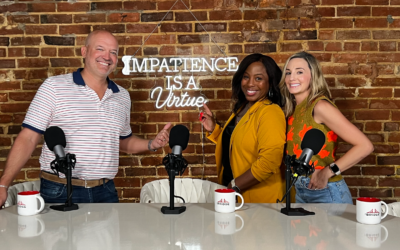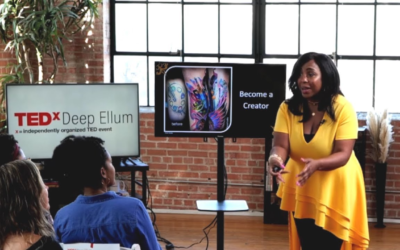

It was a pleasure to join Jeff Crilley in studio on The Jeff Crilley Show. He opened with the question I get most often, and we went from there into generations, AI, and what happens to a team when the person leading it is performing calm.
Here’s what we talked about. Listen to the episode here.
So how do you actually make work suck less?
We spend forty, fifty, sixty hours a week of our actual lives at work.
It’s also where the hardest relationships live. Where the inner critic gets loudest. Where your read on whether you’re doing well or badly gets decided by people having their own week. An enormous share of the stress in a person’s life is generated in that building, or in the corner of the house that became that building.
So I’m not talking about snacks or a better offsite. I’m talking about the fact that a third of your waking life is draining you, and that more of it is workable than it feels.
Not all of it. Some workplaces are genuinely broken and no amount of mindset work fixes a bad system. But the part that lives in how you relate to yourself and the people around you, that part moves. I’ve watched it move a lot.
What does the coaching actually work on?
Three things, in order. I call them the three selves.
Self-awareness. Knowing who you are, what you’re actually thinking, what’s in the backpack of belief systems you’ve been carrying since you were young. The hard part isn’t complexity, it’s honesty. Most of us keep a category called “well, that’s not me,” and a fair amount of what’s in there is, in fact, us.
Self-regulation. Once you know what you’re working with, you can work with it. You learn what activates you, and when the feeling shows up there’s a beat where you can say, I see you, before it drives. Breath work, mindfulness, whatever tool fits your life. The mechanism is the same. The emotion arrives and you are no longer automatically downstream of it.
Self-management. Awareness plus regulation gets you here, and here is where the choices are. You get to be proactive about decisions you were previously just having.
Because this is the part we forget: you are always at choice. Whether you act or don’t. How you respond. What you do with the next ten minutes. There’s more power to create what happens next than a hard day lets you feel.
That’s the ladder. Awareness, regulation, management, and then you’re a creator in your own life instead of a passenger in it.
What does that look like in someone’s real life?
Jeff asked about a favorite success story, and this is the one I always reach for.
I worked with a program manager, lovely woman, running a team of fifteen with fifteen products on her plate. High stress doesn’t cover it. She came in wanting to know how to manage the work.
The work was never the problem. The work was going to be enormous regardless.
What we actually built was her ability to regulate her own stress, to sort what was hers to carry from what belonged to her team, and to develop her own criteria for one useful question: is this a fire right now, or is this just Tuesday?
About three months in, she told me she had news. She’d been to the doctor and he’d cut her blood pressure medication in half. Her stress had come down that much.
Then she told me the part I think about most. She’d started sitting on her back porch in the evenings, and one night her husband came out and asked if she was mad at him. She was so quiet he assumed he’d done something wrong.
She told him no. I’m just regulating.
That’s the version of this work that means the most to me. Yes, people get promoted. Yes, careers move. But the porch is where she actually lives, and that’s what changed.
We have four generations in the workplace. How do we handle that?
It’s a beautiful collision, and it’s a collision.
Gen Z watched us. They saw the burnout, the stress, the jobs that consumed people who weren’t fulfilled by them. So they arrive asking whether there’s a better way, because from where they were sitting there clearly had to be.
That rubs against my elder millennials, against Gen X, against boomers, who have a fair response of their own: we built it this way for reasons, and you’re moving too fast.
Both are legitimate. The failure isn’t the disagreement, it’s the discounting. Well, because they’re young. Well, because they’re old. That move ends the conversation before anybody learns anything.
The alternative is simple and not easy. Get curious about how the other person sees it. Ask what they know that you don’t. Then co-create the culture instead of waiting for one side to age out.
What should people be doing about AI?
I refresh Claude and something has changed again, so I understand why this question makes people tired.
People are landing in different places, and some of that is values. There are people who won’t touch it over the environmental cost. There are people all the way forward. What I’d say to anyone: choose your lane, know why you chose it, and understand what comes with the choice.
If you’re going forward, here’s what keeps getting left out. Learning the tool is the easy half. The half that matters is your critical thinking, because AI is a tool and not a replacement for your reasoning. If you can’t think through a problem, you can’t evaluate what comes back.
Related, and I say this to leaders often: if you can’t communicate clearly enough to delegate to a person, you can’t communicate with the AI either. Same muscle.
And protect your curiosity above all of it. We’ve lost a lot of wonder. Is there a better way to do this. I wonder what would happen if. That instinct, plus these tools, is where new solutions actually come from.
For companies, same fork. Used well, this frees people up for higher-value work. Used as a bandage, it becomes a reason to cut half the workforce, which is the wrong question wearing a strategy costume. The question is how it makes the people you have better.
What about leaders who are great at the work and not the people?
I hear a version of this constantly. I’m excellent technically. People I can take or leave.
Usually that’s a strengths issue rather than a character one. I use CliftonStrengths and Core Clarity in my practice, and plenty of these leaders simply don’t have dominant strengths in relationship building. Fine. So we work out how to use the strengths they do have to build connection, and where the blind spots sit.
If you’re deeply analytical and your team runs on harmony and connection, you’ll have to be more intentional about creating those moments. You’ll also need to say how you like to be communicated with. Talk to me in numbers, I’m a numbers person. Most of us never say that part out loud and then wonder why it feels off. That’s usually what “I don’t like managing people” actually means. Nobody’s speaking the same language, and nobody’s named what they need.
Does a leader have to seem calm?
No, and the performance costs more than the admission would.
We’re all anxious right now. What people don’t want isn’t an anxious boss, it’s a boss pretending. Insisting everything is fine while the room can plainly feel that it isn’t reads as gaslighting, and it builds distrust fast.
Say the true thing. I’m nervous about this one, let’s work out how we handle it. That builds trust.
Be anxious. Know that you are. Regulate through it in the open. People move toward leaders who aren’t pretending to be perfect.
What I’d leave you with
There’s more pressure on people right now than most of us have worked under before, and much of it isn’t resolving soon.
You still have the lever you’ve always had. Notice what’s happening. Regulate it. Then make an actual choice, instead of reacting your way through the afternoon and calling it your personality.
That’s available to you today. It’s also available to the people you lead, who are spending fifty hours a week somewhere too.
Thanks to Jeff for having me.