Think of your favorite character from a movie or a show. I’d put money on this: they changed.
I love television, and specifically I love characters. I won’t start a show unless there’s a podcast about it, because I want to talk about how these people evolve. And somewhere in years of that, I noticed a pattern. The characters with the most growth are almost always the most loved. The forgettable ones end where they started.
Nicholas Cage in National Treasure chases clues for two hours and comes out the same man. John Wick has three films of avenging his dog and remains, throughout, John Wick. Ferris Bueller has an excellent day off and learns nothing.
Now think about Sansa Stark. She starts as a bratty kid who wants to marry a prince and eat pumpkin cakes, gets put through more than anyone on that show, and ends up Queen of the North on her own terms. Tony Stark, who I could not stand at first, all money and no responsibility, becomes a man who lays down his life for people he once found tedious. The Roses lose every dollar and slowly become a family you’d defend in an argument.
We love these arcs. We rewatch them. Then we go back to our own lives and don’t attempt one.
The gap isn’t willpower. Those characters had a room full of professional storytellers building every turn for them. We have ourselves, and a New Year’s resolution that’s dead by January 3rd.
Personality is a tattoo
Here’s the frame that changed how I think about all of this.
A personality gets made the way a tattoo does. Belief systems, values, environment, whatever happened to you at fourteen. It goes under the skin. It reads as permanent. So we assume we’re stuck with what we’ve got.
But think about what people actually do with a bad tattoo. Everyone has a friend with one. You’ve seen it. You’ve said something kind about it.
They don’t resign themselves to it. They take it to an artist who can do something with it. Cover it. Work it into something bigger. Add color. Turn the line that looked like a mistake into the best part of the piece.
You can do all of that with a self. I’ve watched it happen in my own life, my clients’ lives, my friends’. It comes down to five moves, and they are not a sequence. Nobody does these in order.
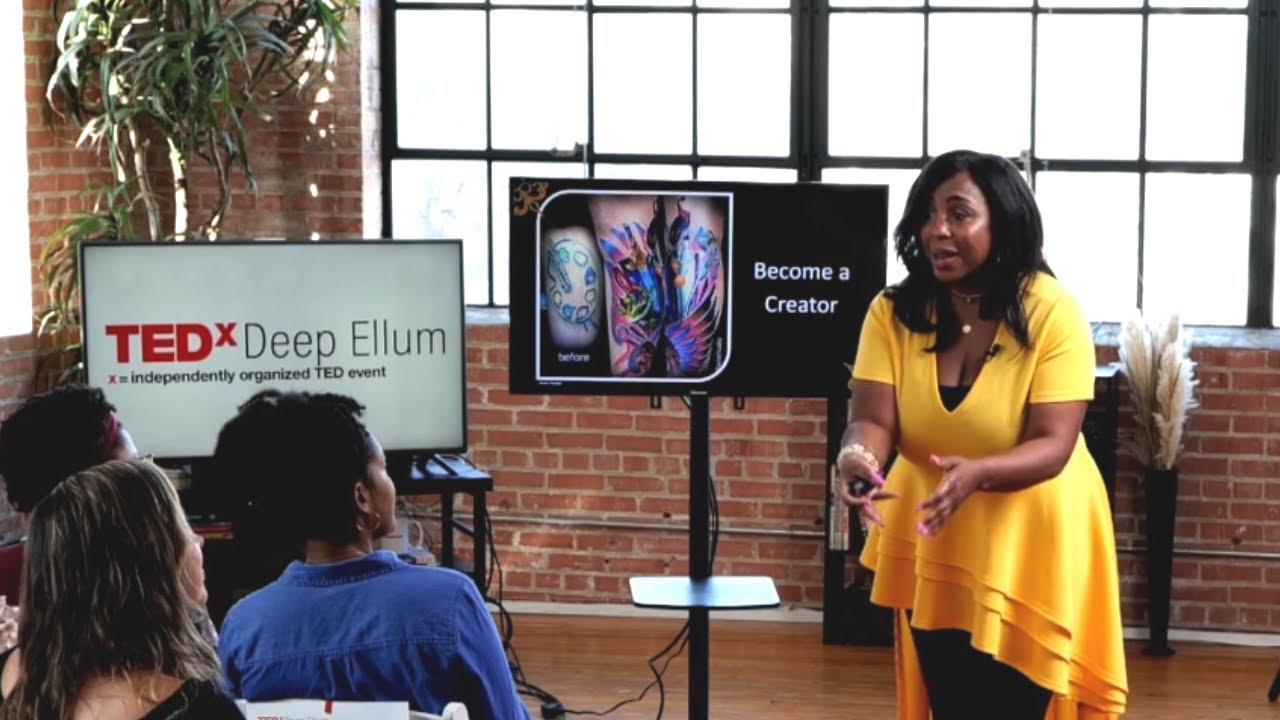
1. Become a creator
To understand being a creator, start with its opposite.
Victimization and victimhood are not the same thing. Every one of us has been victimized by something, whether that’s systemic oppression, a childhood we didn’t choose, or somebody cutting us off on the highway this morning. That’s real, and it isn’t a character flaw.
Victimhood is the mindset that can follow. The choices in front of you go invisible, and life starts reading as something that happens to you.
Being a creator means being at choice. What do I want here. What’s actually available to me.
I started consulting in 2003, fresh out of UT Austin, at Accenture. Back then a consultant had a look and there were rules about it. And in my other hand I held a second rulebook, the one about being a Black woman in corporate America. Work twice as hard. Don’t be too loud. Don’t be angry. Stay under the line. Over ten years I built myself a very well appointed prison.
In the summer of 2013, I wanted braids.
I got on the phone with my girlfriends about it. An actual call. Multiple women. Real deliberation. Would I get fired. Would I get pulled off my client. Would somebody quietly decide I was no longer professional.
Somewhere in that conversation I heard what I was doing. The rules were real, and some of them had teeth. But my belief that I had no say in any of it was mine.
I got the braids. Walked in the next day. Somebody told me my hair was cute. I did not get fired.
One choice made the next one easier to reach, and the next one after that. The muted version of me started giving way to someone considerably more vibrant.
2. Go bigger, add color
Sometimes what you’re working with is fine. Not bad. Just quiet. It could take some color.
What stops most people is the belief that starting something means committing forever. If I take the class, I have to become the kind of person who does that thing. So I won’t start.
A few years ago I was in a leadership program with the owner of a Dallas comedy club, and she told me I should take an improv class. I told her there’s a big difference between being witty in a room and being funny on a stage, and that it was too much. Then one evening, with a certain amount of liquid courage in me, I signed up.
In that class I learned how to play, how to stay in the moment, and that I actually liked myself in front of people. I wouldn’t know any of that otherwise.
And the other kind of experiment: at 38, I decided to try roller derby. I’ll let that sit for a second. I did not know how to skate. Six week class, they said they’d teach us. I bought the gear. I had knee pads. I had a derby name. I was ready.
I spent six weeks skating in a corner.
By any reasonable standard, I failed. What I got instead was proof that I could fail at something and still have a good time, plus one of my better stories. Pick your experiment. You don’t have to be good at it. It makes you more interesting either way.
3. Turn the flaw into a feature
A confession.
I was not a Lizzo fan when she came out. My private assessment was that she was doing too much. All of it. All the time. It took an embarrassingly small amount of honesty to work out that my problem with her was my own body image, sitting in plain sight.
She doesn’t meet the music industry’s beauty standard and never tried to. She took the thing that was supposed to disqualify her and made it the center of the act, and people love her for it.
Same principle, other direction: dad bods. Years of one specific physique, and then a collective quiet decision that soft and warm with emotional intelligence might be the better deal. The flaw became the feature.
Mine is that I’m neurodivergent. Neurospicy, I like to say. I spent years wanting to be normal. Wanting to think in a straight line instead of bouncing between six things. Wanting to be less flaky.
I said that to my best friend once, and she told me it’s what makes me brilliant. That I try things other people won’t.
So I stopped burying it. And the more I let myself bounce, the more people liked working with me. The trait I’d spent a decade managing turned out to be the one I’m known for.
4. Cover it up
Sometimes you look at the thing honestly and it just needs to go.
I once saw a tattoo that was meant as a tribute to someone’s child. In the hands of the wrong artist, it came out looking like a small zombie. And you can imagine the owner’s reckoning. I could live with this. It is not giving what it needs to give. Let me take it to somebody who can handle it.
I have some version of that conversation constantly, with clients and occasionally with myself in the mirror. You hear yourself complaining about the same trait for the fourth time this month. Okay. What do you want to do. Are you going to change it. Is it still serving you.
Some things don’t need reframing. They need work. That’s where transformation stops being insight and becomes a series of small, unglamorous steps past whatever’s been standing between you and the life you keep describing.
5. Find your artist
There’s a thread running under everything above, and it’s easy to miss.
Every tattoo I’ve mentioned was made by somebody else. Nobody does their own.
You can’t see the assumption you’re standing inside. That’s the nature of standing inside it. Somebody else has to say the thing. The comedy club owner said improv. My best friend said brilliant.
Here’s mine. In 2020 my partner got a tattoo I could not stop talking about. Gorgeous. I said, more than once, that I wished I could have one someday. She eventually got tired of hearing me wish and told me that if I wanted it, I should go get it.
Then all the victimhood arrived on schedule. Would I get fired. And I’d come out relatively late in life; I wasn’t sure my mother could absorb two large updates in one year.
We were in Denver with a free afternoon, and we went and found a shop.
In my telling, I was bold and daring in Denver. My partner remembers me kicking and screaming in the car the entire way while she talked me back into the thing I said I wanted.
Both versions are true. That’s what having people looks like. Without her in that car, my arm never lands on the tattoo stand. It’s still my favorite thing I own, and it reminds me every day to be the actual version of myself. My own ink, on my own life.
The beauty of the mess
My therapist, who I should be paying considerably more, once listened to me complain that my life will not sit still. Something is always changing. I wanted to press pause.
She said: the beauty of you is your messiness.
I sat with that and eventually stopped arguing. My life has been messy. It has also been mine.
So. You are not stuck with the version of yourself you settled into under pressure. You can cover it, add color, make it bigger, or leave it exactly as it is because you’ve looked straight at it and you want it.
Change is coming either way. The question is who’s holding the needle.