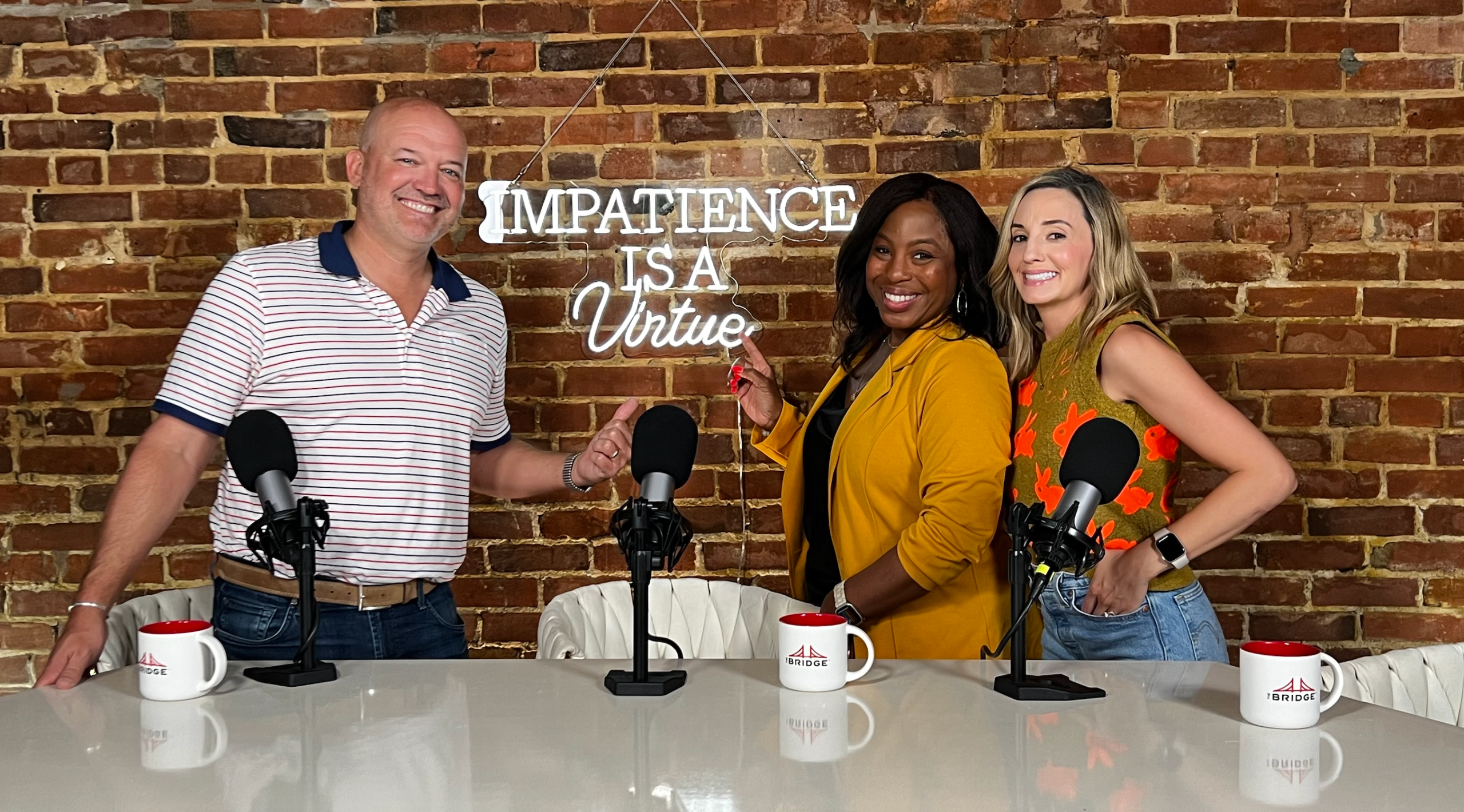
I joined Alyssa and Eric on the Impatience Is a Virtue Podcast. This is the written version of what we got into.
The New Hire Slide
Every consulting firm has “the new hire slide.”
You know the one. It goes up in the deck when you join, and it’s usually a little sad. Here’s where I was born. Here’s a picture of my dog. Here’s a fact about me that I have decided is safe.
I sat down to make mine and understood I had a real decision in front of me. I could go in the box, present the tidy version, be whoever a new person is supposed to be. Or I could put myself on the slide.
I’d already been saying it out loud through the whole interview process. I’m at the stage of my career where I’m tired of the box, so you’re going to get all of this personality. Everyone said bring it. And I remember thinking, are you sure? Because I was still working out who I was, and the box was still very much there.
I built the loud one. Everything I am, a few things I’m not, what I care about, where I spend my time outside of work, the shows, the music, the art, my favorite color. One slide, entirely too much information, completely me.
Here’s the part I want to be honest about, because it gets left out when this story gets told as a moment of courage.
I wasn’t declaring anything. I was running an experiment.
I look at authenticity that way. If I can get away with this slide, and people respond to it, then I’ve found my people. And if the room goes quiet, I’ve learned something too. The reception was a finger in the wind. Can I be me here.
That’s what most people are actually doing when they try something. They’re not making a stand. They’re testing the temperature of a room they can’t afford to be wrong about.
What the experiment was actually testing
That slide wasn’t just personality. It was going up against a stack of definitions I’d been carrying for years.
There’s what a consultant is supposed to look like, which is its own whole thing. Then layer on what a Black woman in consulting is supposed to look like. Not too much of this. Not too much of that. Careful, or you’re aggressive. Careful, or you’re difficult.
Underneath all of it sits a word nobody defines: professional. We use it constantly as though it means something fixed, and it doesn’t. Somebody decided what professional looks like, and it wasn’t a neutral process, and most of us inherited the result without ever asking who wrote it.
So the question I was really testing was whether there was space in that room to stay professional, whatever that means, and still be recognizably myself.
We’ve put the whole job on the individual
This is where I get animated.
We’ve spent years telling people to bring their whole selves to work. Come as you are. We have room for you. And then we sit on our side of the table completely unprepared for what shows up.
Watch how fast it turns into feedback. That person is great, but they need more executive presence.
Executive presence has a look and a feel. Everybody knows what it is and nobody will write it down. So when we tell someone to develop it, we are asking them to file down whatever doesn’t match, and then we call it growth.
I have a full soapbox about performance reviews for this reason. I’ve sat in so many calibration conversations where the note is that someone needs to be more confident. My question is always the same. What does confident look like to you, specifically? Because your version of confidence and their version of confidence can be radically different, and one of them is standing in the room being measured against the other.
Executive presence can be a bright color. It can be a big personality. It can be the quietest person at the table who says the one thing that changes the decision. If we can’t recognize it in more than one shape, we’re not assessing capability. We’re assessing resemblance.
The gotcha problem
Here’s the failure mode I see most, and it does more damage than saying nothing at all.
Someone is told: we want your opinions. Challenge the system. Bring your thoughts.
So they do.
And then at review time: we didn’t love the way you challenged that.
If you invite it and then penalize it, you haven’t built an open culture. You’ve built a trap, and you’ve taught a person that the invitation was decorative. They will never take you up on it again, and they’ll tell their friends.
Don’t ask the question if you’re not ready for the answer.
Trace the thing that bothers you
One of the hosts admitted on air that hats on video calls get under his skin. He’d never said it to anyone. He also wasn’t sure whether it was a real standard or just his preference.
That’s the most useful thing a leader can do out loud, so we worked it in real time.
When something rubs you wrong, trace it back. What exactly is the trigger? What story am I telling myself about what it means? Is there an actual legitimate impact here, or is this bumping against a belief system I happen to have?
Because the leap happens fast. A hat at home means casual. Casual means not taking it seriously. Not taking it seriously means I can’t count on this person. Nobody says that chain out loud, and yet it’s running, and it will show up months later as a vague comment in a review that the person can’t do anything with.
Sometimes you trace it and find a real standard worth naming. Often you find your own conditioning, or a person who was having a hard morning.
He also told a story on himself that I loved. Years ago, one of his salespeople, several levels junior, told him after a client meeting not to chew gum again. His first reaction was who does this guy think he is. His second was: yeah, why was I chewing gum.
Both reactions are correct. That’s the work.
Authenticity is a ladder
When a leadership team decides to open the culture up, the instinct is to announce it. We’re going to be an authentic organization, starting Monday.
Zero to a hundred does not work, because there’s a trust factor that has to be built and you can’t declare trust into existence. People will watch what happens to the first person who tries.
So the question is what zero to one looks like. What’s the smallest true thing a leader can model this week? Culture gets incrementally more honest, and it moves at the speed of the evidence people are gathering.
Because they are gathering evidence. Our brains are built for it. If I do this, what happens? Everyone in your organization has a running hypothesis about what’s safe here, and it was formed by watching how you reacted to somebody else.
The clearest example from the show: there’s a guy in their office who walks around in his socks. All the time. One of the hosts teases him about it constantly. He does not care. It has become a running joke and, at this point, part of the culture.
It’s a small, silly thing. It’s also permission. Somebody else in that office saw that a person could be visibly himself, get teased, and remain entirely fine. That’s data, and it will show up later as somebody asking a braver question in a meeting.
You’re allowed to have rules
None of this means an organization can’t have standards.
You have every right to set rules of engagement. Shoes are required here. This is how we run a sales meeting. Say it out loud, as a stated non-negotiable, and it stops being a trap.
My favorite version of this sounds like: in client meetings, we lead with empathy and compassion. Now, whatever your authentic way of showing empathy is, do that.
That’s the balance. The standard is named. How you meet it is yours. And someone can look at your actual, stated culture and decide whether they fit, instead of spending a year decoding it and getting it wrong.
The same logic applies to reading a room. Being authentic doesn’t mean being identical in every setting. I can be fully myself and still register that this client is formal and that one is casual. Emotional intelligence and authenticity are not opposites. Authenticity isn’t only what you wear. It’s the question you ask, the point you’re willing to challenge, the moment you say this is my read even though it isn’t the popular one.
What they think of you
The question I hear more than any other in coaching: if I do this, what will they think of me?
They’re going to think something regardless. Yes, no, or nothing at all. You cannot control it, and trying to means managing variables that were never yours. That person may be short with you because Starbucks got their order wrong.
So the more useful question is how you want to show up in this moment so that you’re proud of yourself walking out of it.
Now, the counterweight, because this can curdle fast into an excuse. There is real truth in feedback. If the same note keeps arriving from different directions, take it in. Understand the impact you’re actually having. And if that impact doesn’t line up with your own values, that’s exactly when you change something.
“This is who I am, take it or leave it” is not authenticity. It’s a wall with better branding.
One more thing
I’ll say the quiet part: it’s a point of privilege to be at this stage of a career and speak this freely. Nobody is going to fire me over a slide.
Which is precisely why the work belongs to the people with the most room to move. If you’re leading, the experiment isn’t yours to run. You’re the conditions other people are running theirs in.
Somebody on your team is deciding this week whether to say the thing. They’re watching what happened to the last person who did.